
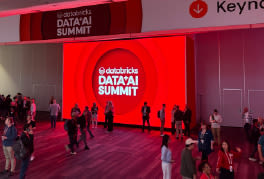
Ali Ghodsi opened the Summit with a line that stayed with us: “AGI is here, but not at work yet.”
That observation 1) sparked some animated debate, and 2) framed everything that followed in the Summit. And the quote is worth sitting with: it reveals something important about where the industry is, and where Databricks is positioning itself.
The pace of change is astounding. The 2025 Data & AI Summit left us thinking: “Wow, Databricks is really innovating in this space.” 2026 has shown that the evolution never stops and the innovations just keep coming!
At the 2026 Summit Ali Ghodsi introduced a new angle to a seemingly complete data platform: if you want AI to really perform for your business, give it context. Databricks wraps this “business context” angle into 4 key pillars of the platform: Context, Control, Cost and Choice. These “Four ‘C’s” guided the strategy and considerations underpinning the latest products and launches.
Our takeaway is simple: Databricks is powering ahead with innovation and AI, and the job for us all now is to align and understand how we apply this to our own organizations to deliver true business value.
We’ve pulled out a few highlights below.
1. AI, In Context with Genie Ontology
If there’s one announcement that deserves the spotlight, it’s Genie Ontology.
Genie Ontology is more ambitious than a standard metadata layer. Genie Ontology is Databricks’ answer to a question that’s plagued enterprise AI since the beginning: How do we enable LLMs to actually understand our business?
The approach until now has been to throw data at models and hope they figure it out. The result? Agents that “take random walks” through your data, burning tokens, returning unhelpful responses because they don’t understand your business Context, your terminology, or what “trusted” looks like in your organization.
Genie Ontology flips this. It builds a learned context graph automatically in the background, using OntoRank (Databricks’ spin on PageRank) to determine trusted sources, trusted authors, and meaningful connections across all your knowledge systems, not just data lake assets, but SharePoint, Google Drive, meeting notes, and more. You can inject business context manually, but the system continuously learns.
Then (and this is the clever bit) every other product in the Databricks suite (Genie One, Genie Code, Genie Agents, Genie Zero Ops) is informed by that same ontology. They are all guided by that same business context.
Why this matters for clients: If your organization needs a gentle nudge to invest in data cataloging, semantic modelling, and business glossaries, Genie Ontology promises to be that catalyst.
But here’s the catch: The quality of your context graph depends on the quality of your upfront investment in metadata and business logic. Databricks states an accuracy of 80%+ on queries; when making practical business decisions, you need to determine whether that is enough certainty to act upon.
2. The Right Way: Unified Governance
The second shift we noticed is more subtle but perhaps more important: AI governance is no longer just an IT department problem.
When Databricks announced Unity AI Gateway, the framing was deliberate. AI governance is now a whole-company problem of Cost and Control. And they’re right.
When every business function is spinning up agents, calling APIs, and consuming tokens at scale, Cost and risk become enterprise-wide challenges overnight. The focus shifts from “token maxing” to “maxing value per token” and managing the cost of AI.
What we’re hearing from clients: They want AI governance frameworks before they deploy AI at scale. Not after. Unity AI Gateway provides the tooling, but tooling alone isn’t sufficient. The policies, accountability structures, and organizational discipline need to come first.
That’s where we see an opportunity for competitive advantage. Databricks has built the Control plane. The harder work (defining policies that actually work for your organization, designing governance workflows, connecting AI investment to business outcomes), that’s where many organizations will need to place their focus.
And then we have Omnigent, Databricks’ meta-harness for agents. It’s not just a feature; it’s an architectural statement. The idea that you need a layer above your agents that allows composition, collaboration, and contextual policy-setting (including budget approval workflows) reflects a maturity that the market is just catching up to.
3. An Intelligent Platform: Super-Charging Your Data Layers
The purpose of storing and maintaining data is to use it.
Lakehouse//RT promises to deliver real-time query performance directly on your existing lake table infrastructure. Powered by Reyden’s warehouse technology (positioned as the world’s fastest, scalable SQL engine), it could open up more real-time and direct querying without the need for intermediate aggregated or cached layers to achieve the desired performance levels.
Our take: Lakehouse//RT is compelling for organizations with moderate query volumes and Cost flexibility but warrants careful Cost modeling before committing to it as a replacement for traditional BI semantic layers.
There’s one more announcement worth mentioning: Lake Transactional/Analytical Processing (LTAP).
On its surface, LTAP solves a technical problem that’s existed for 20+ years: the separation between OLTP (transactional systems with high read/write) and OLAP (for data analysis operations). Most organizations maintain two separate systems, with data flowing between them via complicated and tedious pipelines, always with lag and complexity.
LTAP unifies them by mirroring changes from Postgres (row-oriented, transactional) into Delta/Iceberg (columnar, analytics) with sub-second latency. One shared copy of the data. No batch jobs. No stale analytics.
It’s elegant. And it solves a real pain point.
But here’s what we’re watching: Lakehouse//RT, in combination with Reyden, unlocks a new class of use cases. If your operational data is immediately queryable for analytics, the economics of AI applications change. Agents can tap into live transactional context. Real-time decision making becomes feasible. The distinction between “operational systems” and “AI systems” starts to blur.
4. Optionality is Key: Open Infrastructure as a Strategic Moat
One consistent theme throughout the summit: avoiding lock-in is hard, but maintaining Choice is critical. “Any data, any model, any cloud, no lock-in”. Databricks is doubling down on open standards: Delta Lake, Apache Iceberg, open sharing, cross-cloud failover, even on-prem deployments. The new Reyden warehouse is built on open formats.
This aligns directly with Thorogood’s long-standing vendor-independent philosophy. We find Databricks a compelling platform not only because of its vast capabilities, but because of the flexibility and platform independence that it provides. Your data strategy should always prioritize optionality. Optionality gives you freedom and meaningful Choice.
Satya Nadella’s conversation with Ali Ghodsi crystallized this: an organization’s true competitive advantage is its tacit knowledge-the learned intelligence embedded in data, processes, and people. You can’t outsource that learning. And you shouldn’t outsource it to a vendor architecture you can’t escape.
5. AI As a Means For Business Value
AI isn’t an end; it’s a means.
Your end should always be locked on to the delivery of real value to your business; Databricks is offering the AI-enablement to get you there faster, with more greater accuracy and with lower barrier to entry. At the conference there were, predictably, a raft of AI-driven announcements; all underpinned by Genie Ontology that ensures you are working within the context of your business.
Genie One, announced last year as the business interface to interact with your data, abstracted from the technical complexities of the traditional Databricks interface now, super-charged by Genie Ontology.
Genie Code, now more capable than ever, with a greater understanding of your business and extended to enable the creation of ML models.
Use Genie Zero Ops to proactively monitor your data pipelines, identify issues, perform a root cause analysis and offer suggested fixes, for a human to accept or reject. It even extends into the MLOps space, monitoring model health and data drift.
Genie Agents turn a conversation into an agent. Users can spin up Agents from Genie One or Genie Code to “vibe code” your app, again, powered with an understanding of your business through Genie Ontology.
Agentic Apps, via Databricks Apps, allows enterprises to build apps to run directly in their data environment.
Agent Bricks provides a streamlined platform for building, evaluating, and optimizing production-grade AI agents on your enterprise data.
Our message to our clients is this: AI isn’t the goal. It’s a way to achieve your goals.
Greg Brockman, co-founder and president of OpenAI, spoke of OpenAI’s emphasis on ‘keeping humans at the centre’. That’s not just ethical positioning – it’s practical. The organizations that will extract the most value from agentic AI are those that redesign workflows around human-agent collaboration, not those that simply automate existing processes.
Implication for clients: The question to ask isn’t “should we use agents?” – it’s “which decisions and workflows are genuinely agent-ready?” The business case for any AI or agent deployment still needs to be grounded in specific, measurable outcomes. We’d recommend a structured agent readiness assessment before committing to a platform build.
6. The Bottom Line: Technology Isn’t the Constraint Anymore
Here’s what we’re taking back to clients: the pace of innovation is fast and the potential is enormous. We can help you navigate it.
Genie Ontology requires you to have done the foundational work on metadata and semantics. Unity AI Gateway requires you to have thought through governance frameworks and Cost discipline before you deploy. Genie Code and Genie Zero Ops require both talent strategy and organizational readiness.
These aren’t technology constraints. They’re organizational and methodological considerations.
That’s what “Data & AI: The right way” means in practice. Not the fastest route to a demo or a quick proof of concept. The right architecture, the right governance, the right foundations so that when you deploy AI at scale, it works, it’s trusted, and it delivers lasting value.
The tools are maturing and the vision is crystallizing. Now comes the hard part: using them wisely, efficiently, and effectively. Even the most “complete” platform requires a deep understanding of business objectives, careful and intentional planning, and thoughtful execution.

